
Your Q3 2026 global market update

15 October 2026
Each quarter, we share a global market update, summarising significant events across major stock market indices.
Following a sharp drop at the end of July due to the global semiconductor sell-off, markets recovered relatively well.
Below is a table showing the performance of six key world indices in Q3 2026, the previous quarter’s results, and the results from 2025.
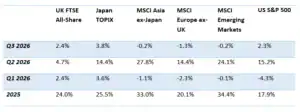
Source: JP Morgan
Meanwhile, further pressures on energy prices, sticky inflation, and more policy tightening proved challenging for global bond markets.
Keep reading for further insight into some of the main events influencing these results.
Geopolitics and macroeconomic tensions continue to dominate headlines and market performance
Despite previous attempts to reach a resolution, the war in the Middle East continues to rumble on. Renewed geopolitical tensions and higher oil prices towards the end of September revived inflation fears, putting government bonds under pressure, and causing concern over future interest rates.
While the S&P 500 gained 2.3% over the quarter, the FTSE All-Share rose 2.4%. European equities were weaker, and Asian markets were mixed.
UK
Thanks to exposure to financials, energy, and weight in commodity-related sectors, plus attractive valuations and strong dividends, UK equities fared well during the quarter.
The performance of UK government bonds, however, was less encouraging. Gilt yields rose during the quarter, reflecting the global increase in borrowing costs, concerns about the fiscal outlook, and inflationary pressures.
Accordingly, high energy prices continue to impact inflation, which stood at 3.1% in the year to August – the highest rate in five months.
Though the Bank of England held interest rates at 3.75% in September, it warned of likely rises if energy prices remain high.
The Office for National Statistics (ONS) reports that the UK economy grew by 0.5% in the second quarter of 2026, revised up from an initial estimate of 0.4%.
Meanwhile, other ONS data showed UK debt stood at a little below £3 trillion, equal to 93.8% of GDP at the end of August. As such, Chancellor John Healey is widely expected to increase taxes in the Autumn Budget on 28 October 2026, with the BBC reporting that the chancellor has “refused to rule out tax increases” after acknowledging government borrowing costs are at historic highs.
US
The S&P 500 enjoyed several record highs over the summer months, driving growth through robust business investment, artificial intelligence (AI)-related capital expenditure, and a strengthening labour market.
Towards the end of the quarter, renewed tensions in the Middle East disrupted energy supplies and pushed oil prices higher, reigniting concerns that inflation could remain elevated.
The Federal Reserve responded to sticky inflation by raising its target interest-rate range by 0.25 percentage points in September, to 3.75% – 4.00%. In its policy statement, the Fed noted that “economic activity is expanding at a solid pace”, with resilient domestic spending and robust capital investment.
The bond market faced a more difficult time. According to Morningstar, US Treasury yields rose sharply during the quarter, with the 10-year yield reaching 5.28% at quarter-end.
For investors, events of the last quarter highlight the importance of holding a well-diversified portfolio. While earnings growth continues to support equities, higher interest rates and geopolitical uncertainty may contribute to further volatility.
Eurozone
European equities struggled towards the end of the quarter as higher energy prices and rising bond yields dampened investor sentiment.
Inflation moved higher, driven in part by energy costs.
Eurostat’s August release reported annual eurozone inflation of 3.2%, up from 2.9% in July. This renewed pressure hampered the European Central Bank’s task of bringing inflation sustainably back to its 2% target.
Government bond yields rose across the region, reflecting concerns about inflation, the cost of government borrowing, and the prospect of tighter monetary policy.
Meanwhile, economic growth offered some reassurance, with the eurozone economy expanding by 0.4% in the second quarter. Nevertheless, the region remains exposed to higher imported energy costs and geopolitical uncertainty.
Asia
Asian markets produced mixed results during the third quarter. According to Bloomberg data reported by Ninety One:
- Hong Kong’s Hang Seng Index gained 8.6%
- China’s Shanghai Composite fell 6.2%
- Japan’s Nikkei 225 declined 4.2%.
Technology remained an important influence; changes in investor sentiment towards AI and semiconductor companies contributed to volatility, particularly in North Asia.
Hong Kong equities benefited from renewed interest in Chinese technology businesses, while mainland shares faced pressure from concerns about domestic demand and higher global borrowing costs.
The rise in oil prices also created challenges for energy-importing economies, including China, India, and Japan.
As a direct consequence of higher import costs, inflation, currencies, and corporate profitability were all feeling the pressure.
Speak to us about carefully managing your investments
The third quarter of 2026 has been relatively stable, with investors enjoying some moderate growth after a sharp market dip at the end of July.
As events continue to unfold and influence markets in the coming weeks or months – particularly in light of the UK Autumn Budget and the US midterms – we are here to guide you through periods of uncertainty and ensure you remain informed.
No matter where you are on your investment journey, our team can help you build and manage a diversified portfolio designed to weather market volatility while allowing you to achieve your long-term goals.
Email [email protected] or call 0161 8080200.
Please note
This article is for general information only and does not constitute advice. The information is aimed at retail clients only.
All information is correct at the time of writing and is subject to change in the future.
The value of your investments (and any income from them) can go down as well as up and you may not get back the full amount you invested. Past performance is not a reliable indicator of future performance.
Investments should be considered over the longer term and should fit in with your overall attitude to risk and financial circumstances.