
Q3 investment update

In line with the last two quarters, the coronavirus pandemic has dominated sentiment regarding the global economy. After deep falls in markets in the spring, there have been signs of recovery in the third quarter, as lockdowns ease and many businesses return to something approaching normal.
Here’s a look back at Q3 in your quarterly market update.
UK
While stock markets across the globe continued to recover in the third quarter, UK equities fell by almost 3% and are down around a fifth since the start of 2020.
| Q3 2020 | 2020 year to date | |
| MSCI Asia ex-Japan | 10.8% | 5.6% |
| MSCI Emerging Markets | 9.7% | -0.9% |
| US S&P 500 | 8.9% | 5.6% |
| Japan TOPIX | 5.2% | -3.4% |
| MSCI Europe ex-UK | 1.8% | -7.4% |
| UK FTSE All-Share | -2.9% | -19.9% |
Source: JP Morgan
Government stimulus is also coming to an end in the UK, which could further impact the wider economy. The Chancellor announced a new Job Support Scheme that is significantly less generous than the ‘furlough’ scheme which ends in October, and so experts predict a rise in unemployment in the fourth quarter. Around 10% of all jobs remained on furlough at the beginning of September 2020.
In addition, markets remain concerned about the possibility of a ‘no-deal’ Brexit as the UK exits the European Union in 2021. While there is still time for a free trade agreement and transition arrangements to be agreed, the risk of a more adverse scenario is increasing.
Markets suggest that the Bank of England will introduce negative interest rates at some time in 2021, with ten-year gilts ending the quarter at 0.25%, down from 0.8% at the start of 2020.
US
Despite the most significant drop in GDP since the Great Depression, the US stock markets have recovered strongly since plummeting in Q1.
The S&P 500 index opened on 1 January at 3,230 and closed on 30 September at 3,363 – up more than 4% over the year. Indeed, on September 2, 2020, the S&P 500 index closed at a record high of 3,580.84 after hitting an intra-day high of 3,588.
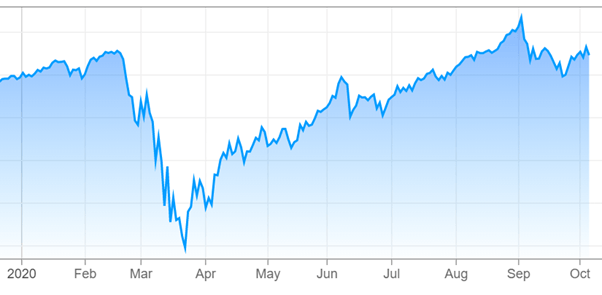
Source: CNBC
Despite rising markets, a high level of uncertainty continues mainly due to the unknown impact of a second wave of coronavirus, possible further lockdowns, and the likelihood of a viable vaccine.
The upcoming US presidential election has also contributed to economic uncertainty. Polls suggest a Biden victory – although these are the same polls that predicted a Clinton triumph in 2016. If you look back at every election year since 1945 the market is, on average, negative in a quarter when the incumbent loses.
The US unemployment rate dropped to 8.4% in August, down from 10.2% in July and below consensus expectations of 9.8%. However, initial and continuing jobless claims remain stubbornly high. Even though the Fed has revised down their expectations for unemployment, the unemployment rate is still expected to remain above 5% until 2022.
Without any further fiscal stimulus, consumer spending is predicted to slow. Although consumer spending increased 1% in August, lower unemployment assistance resulted in personal income declining 2.7% relative to July.
Europe
While the US markets continued to bounce back, European equities lagged behind the rest of the world, with returns of just 1.8% in the third quarter.
This was partly due to Covid-19 infections rising sharply in several countries, notably France and Spain, which resulted in tougher restrictions to curb the spread of the virus.
However, unlike in the UK, many countries have renewed support measures for workers affected by Covid-19. Several countries, including Germany, have extended their furlough schemes to protect jobs through the autumn and winter.
In July, the EU approved a €750 billion fund to help member states recover from the pandemic. The European Commission will borrow this money, guaranteed by all EU member states, and €390 billion of grants and €360 billion of loans will be distributed.
In line with the UK Eurozone, annual inflation fell in Q3. Indeed, annual inflation turned negative, at -0.2% in August compared to 0.4% in July.
Asia and emerging markets
The third quarter of 2020 emphasised the benefits of diversifying investments geographically as well as by asset class. Asian equities returned more than 10% in the three months and are the joint best-performing equity region in 2020 to date, up by more than 5%.
India, Korea, and China were particularly strong, with their markets posting double-digit returns and outperforming the MSCI Asia ex-Japan index.
Emerging market equities returned 9.6%, in the quarter, while Japanese shares also gained in Q3 after Yoshihide Suga replaced outgoing prime minister Shinzo Abe.
Get in touch
If you have any questions about markets, investments, or the outlook for equities, please get in touch. Email info@depledgeswm.com or call (0161) 8080200.