
Your Q1 2026 global market update
17 April 2026
Each quarter, we share a global market update, summarising significant events across major stock market indices.
If you follow the financial news, you may already be aware that the first quarter of 2026 has presented multiple challenges for markets and the global economy.
Below is a table showing the performance of six key world indices in Q1 2026 and in the previous year.
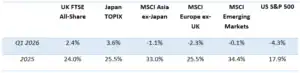
Source: JP Morgan
Continue reading for a closer look at some of the main events influencing these results.
Oil prices rising and ongoing uncertainty
On Saturday 28 February, the US and Israel began strikes on Iran. This led to markets falling when they reopened on Monday 2 March.
The FTSE 100 recorded its biggest loss since November 2025, when it fell 1.2%. While airlines, luxury goods makers, and banks were among the worst affected sectors, defence stocks increased.
Because the Middle East is a major region for oil exports, the conflict led to prices rising. The war has all but halted shipments of oil and liquefied natural gas through the Strait of Hormuz, which typically carries about one-fifth of the world’s gas and crude supply. The International Energy Agency has described the situation as causing the “biggest-ever oil supply disruption”.
Brent oil prices jumped 63% in March – the largest monthly increase in four decades.
On Wednesday 1 April, oil prices rose by nearly 7% after US President Donald Trump repeated threats to hit Iran “extremely hard” in the coming weeks and failed to share details on how the war may end.
Following the speech, Brent crude rose to $107.60 a barrel.
The price of oil and gas will likely continue to fluctuate as the situation unfolds.
UK
While elevated geopolitical tensions have created uncertainty across the world, the commodity-strong UK FTSE All-Share delivered positive returns of 2.4% in the first quarter of 2026.
This modest yet positive performance was primarily led by large, internationally focused companies in mining, defence, and other commodity-linked sectors.
Another upside for UK stocks is that a weaker pound continues to attract overseas investment.
On 3 March 2026, Chancellor Rachel Reeves delivered the government’s Spring Statement. In it, she said inflation would fall faster than expected, economic growth would pick up in 2027 and 2028, and there was headroom in the budget.
However, the calculations were made before the conflict in the Middle East began.
While UK inflation fell to 3.2% in the 12 months to February 2026, the war in Iran and subsequent energy shock could lead to greater inflation, in part because of the high dependency on natural gas.
Indeed, reports suggest that the Office for Budget Responsibility estimates the Iran war would add 1% to UK inflation this year.
Meanwhile, the Guardian reported that the Food and Drink Federation estimates that prices could “rise by ‘at least’ 9% by the end of 2026, almost tripling a forecast of 3.2% that was made before the Middle East conflict”.
High inflation may lead to the Bank of England (BoE) increasing interest rates, which would place pressure on consumers and businesses.
Though the BoE voted unanimously to keep interest rates on hold at 3.75% in March, it gave strong indications that it will hike interest rates if necessary.
US
The S&P 500 finished 4.3% down in the first quarter of the year.
As investor sentiment softened due to concerns that AI capabilities threatened software as a service (SaaS) models, tech stocks had a challenging start to 2026.
Indeed, from the beginning of 2026 to the end of February, US software stocks fell by 23%.
Although many technology stocks posted strong Q4 earnings, more investors started to scrutinise whether “hyperscalers” could continue to deliver returns against the ever-increasing levels of AI capability being reported.
However, in the first few weeks of the Middle East conflict, the tech sector proved slightly more resilient than the broader US market, with investors turning to higher-quality companies during elevated economic uncertainty. Even so, the tech sector was down 3.8% in March (compared to -5.0% for the wider US market).
US Treasuries proved relatively resilient and were flat during Q1 2026. Thanks to its position as a net energy exporter, the US is somewhat insulated from the spike in energy prices.
Meanwhile, the cooling US labour market may help to keep price pressures at bay. The US economy lost 92,000 jobs in February. The ongoing conflict might lead businesses to take a more cautious approach in the coming months.
Eurozone
Elevated tensions in the Middle East shook European markets, with the MSCI Europe ex-UK Index falling 2.3%.
Though the steep rise in European gas prices didn’t reach levels seen in 2022, it still caused concern for Europe’s growth outlook.
The European Central Bank (ECB) left rates unchanged at its March meeting but strongly signalled the possibility of rate hikes.
In updated staff projections, the ECB’s baseline scenario predicts that inflation could 3.1% year on year in Q2 2026 and doesn’t account for the peak in energy prices seen in March, as this forecast is based on market movements up until 11 March.
Across the eurozone, the annual inflation rate rose to 2.5% in March 2026, up from 1.9% a month earlier. Due to the war in the Middle East, headline inflation is now expected to average 2.6% in 2026, 2.0% in 2027, and 2.1% in 2028.
While the ECB held interest rates in March, it warned that uncertainty could lead to higher inflation and pose risks to economic growth, which might lead to higher interest rates in the coming months.
Asia
Despite coming under pressure from geopolitical tensions and fluctuating energy prices later in the quarter, the export-oriented TOPIX Index was up 3.6% at the end of March 2026.
Contributing factors include a weak yen and the decisive victory for the ruling Liberal Democratic Party in February’s snap election. Investors expect this to result in looser fiscal policy and more growth opportunities for Japanese stocks.
At its March meeting, while the Bank of Japan (BoJ) left the key short-term rate at 0.75%, it didn’t rule out the possibility of rate hikes.
Meanwhile, CPI inflation is expected to dip below 2% temporarily before facing renewed upward pressure from rising crude oil prices.
Elsewhere, South Korea’s KOSPI index ended the quarter up 20%, though down 20% from its peak on 27 February, the day before the US and Israel attacked Iran.
Speak to us about carefully managing your investments
The first quarter of 2026, especially the final month, has been far from comfortable.
At Depledge, we understand just how quickly global conditions can change. Our team can help you build and manage a diversified portfolio designed to weather market volatility while allowing you to achieve your long-term goals.
Email [email protected] or call 0161 8080200 to find out more.
Please note
This article is for general information only and does not constitute advice. The information is aimed at retail clients only.
All information is correct at the time of writing and is subject to change in the future.
The value of your investments (and any income from them) can go down as well as up and you may not get back the full amount you invested. Past performance is not a reliable indicator of future performance.
Investments should be considered over the longer term and should fit in with your overall attitude to risk and financial circumstances.